
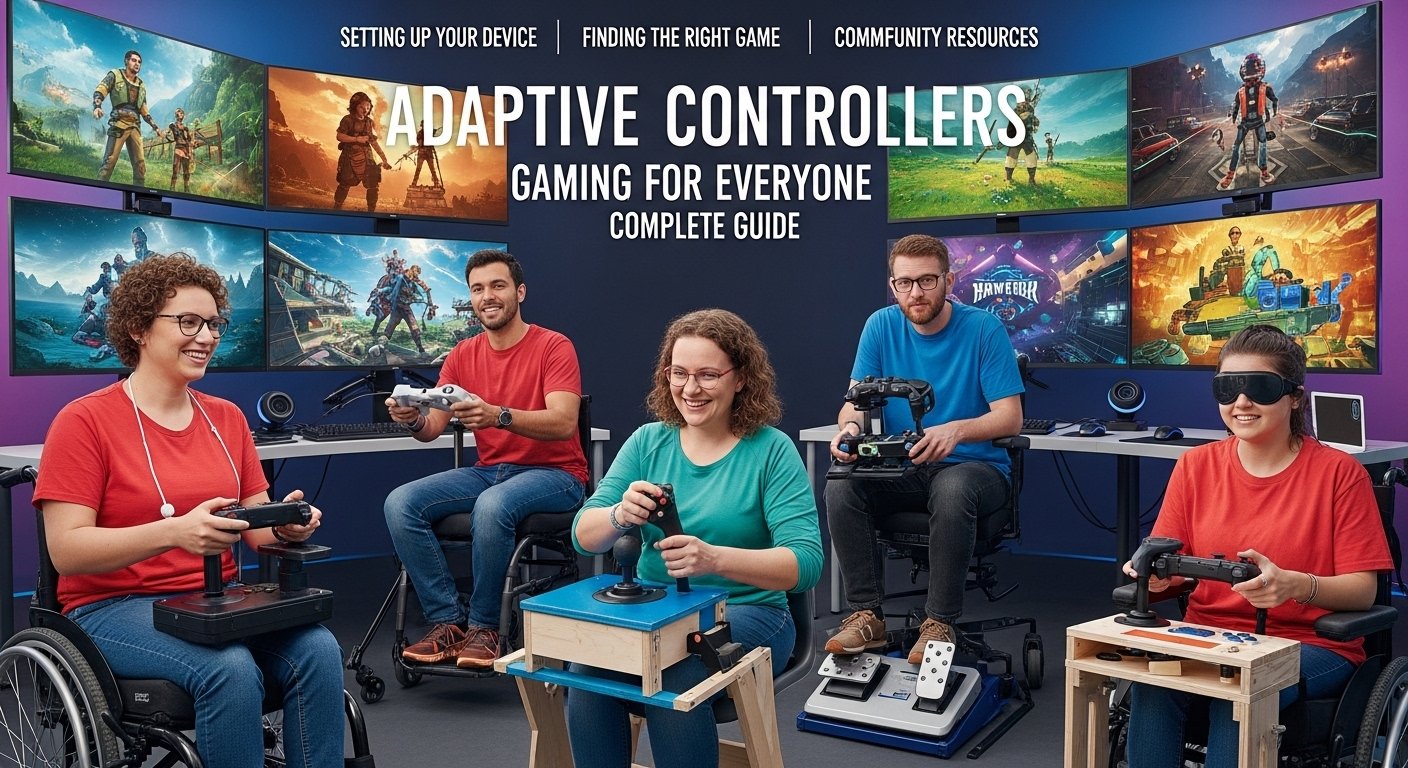
Adaptive Controllers: Gaming for Everyone.
Did you know that for millions of passionate individuals, the simple act of holding a standard game controller can be an insurmountable barrier to joining the thrilling worlds of video games? It’s a reality many able-bodied gamers rarely consider, but it paints a clear picture of the vast untapped potential and desire within the gaming community. But here’s the exciting news: the landscape of play is transforming thanks to incredible advancements in adaptive controllers: gaming for everyone is not just a dream, but a rapidly expanding reality. These innovative devices are knocking down traditional barriers, ensuring that everyone, regardless of physical ability, can dive into their favorite virtual adventures, connect with friends, and experience the pure joy of gaming.
Demystifying Adaptive Gaming Controllers: What Are They?
At its core, an adaptive gaming controller is any input device thoughtfully designed to allow individuals with diverse physical needs to play video games effectively and comfortably. Think of it not as a single product, but as an entire philosophy centered on inclusivity and personalized interaction. Traditional controllers, while ergonomic for many, often assume a specific range of motion, hand strength, and dexterity. For someone with limited fine motor skills, tremors, significant limb differences, or single-limb use, these ingrained assumptions create a fundamental roadblock to participation.
These specialized tools go far beyond mere button remapping; they fundamentally rethink how we interact with games. From modular systems that act as central hubs for various custom inputs to highly specialized devices responding to unique movements like eye-gaze or breath, accessible gaming controllers are all about providing a rich array of options. The overarching goal is simple yet profound: if you want to play, there should be a viable, enjoyable way. It’s about empowerment, meticulously breaking down the wall between a player’s desire to engage and their physical ability to execute in-game actions, fostering true independence in the digital space.
- Personalized Play: Unlike generic gamepads, adaptive controllers aren’t a one-size-fits-all solution. They are typically highly customizable, allowing players to meticulously tailor their setup to their exact physical capabilities. This ensures not only comfortable but also genuinely effective and enjoyable gameplay, optimizing every interaction.
- Breaking Down Social Barriers: These devices transform gaming from an exclusive club into an open, welcoming invitation. This opens up immense social opportunities, competitive avenues, and even therapeutic benefits for a demographic that has historically been underserved or entirely overlooked by mainstream gaming hardware and design.
- Empowering Independence: For many users, the ability to control their gaming experience independently is an incredibly liberating and empowering feeling. It fosters a profound sense of accomplishment, mastery, and self-reliance that radiates far beyond the virtual world, impacting daily life and confidence.
The Diverse World of Assistive Gaming Devices: A Comparison
When we talk about assistive gaming devices, we’re actually referring to a wide and fascinating spectrum of innovative solutions. To help you navigate this exciting and sometimes complex landscape, we’ll compare three primary approaches that currently stand out in the field. Each offers distinct advantages, caters to different user needs, and aligns with various preferences. Understanding these foundational categories is absolutely key to finding the perfect fit for yourself or a loved one, making truly inclusive gaming technology a tangible, accessible reality for more people than ever before.
1. Modular Hub Systems: The Adaptable Foundation
Imagine a central, highly flexible control panel that allows you to plug in almost any kind of input device you can think of, then seamlessly integrate them into your game. That’s the powerful essence of a modular hub system, with the widely recognized Xbox Adaptive Controller (XAC) being the most prominent and impactful example currently available. This approach isn’t a controller itself in the traditional sense, but rather a robust, intelligent platform designed to integrate an astonishing array of external switches, oversized buttons, specialized joysticks, foot pedals, and many other peripheral inputs. It’s truly like a universal adapter for your body’s unique and specific way of interacting with a game, translating diverse physical movements into standard game commands.
The profound beauty of these systems lies in their sheer flexibility and incredible potential for customization. A player might strategically use a foot pedal for jumping, a large, easily activated button near their head for shooting, and a precise traditional joystick manipulated by their chin for character movement. The central hub intelligently translates all these diverse and unique inputs into standard controller commands, making complex gameplay possible. It wholeheartedly supports a “build-your-own” philosophy, empowering users to create a truly bespoke and personalized setup. These systems are typically well-supported by major gaming platforms, offering seamless integration and extensive remapping capabilities directly from the console or PC interface. Crucially, they allow for dynamic adjustments as a player’s needs or even the demands of different games might change over time, ensuring unparalleled longevity and adaptability.
Key Takeaway: The XAC and Similar Hubs
Modular systems like the Xbox Adaptive Controller excel in their unrivaled versatility and deep customization. They are ideal for players who require a complex, multi-modal input setup and greatly benefit from the ability to mix and match various external peripherals to meticulously create their absolutely perfect gaming interface, adapting as needed.
2. Specialized Single-Purpose Controllers: Tailored for Specific Needs
Moving beyond the broad modularity of hub systems, we encounter a vast and ingenious array of specialized gaming controllers, each meticulously designed to address a particular type of physical interaction or overcome a unique limitation. These aren’t just mere accessories; they are often standalone, integrated input devices built from the ground up with specific functions or medical conditions in mind. Think about remarkable devices like sip-and-puff controllers for quadriplegics, which ingeniously translate subtle breath patterns (sips and puffs) into directional inputs and button presses, or robust, large-button joysticks designed with minimal force requirements for individuals with severely limited hand strength or dexterity.
Other compelling examples include ergonomic single-handed controllers that ingeniously condense all the complex functions of a standard gamepad into a layout manageable by just one hand, or even sophisticated eye-tracking systems that empower players to navigate intricate menus, select options, and perform in-game actions purely with their precise gaze. These devices often represent the cutting edge of gaming controllers for disabilities, providing elegant and effective solutions for very specific and sometimes profound needs where a traditional controller, even with advanced remapping, simply wouldn’t suffice. They prioritize intuitive and efficient control for a highly specific user profile, often requiring less initial setup than a complex modular system but offering less inherent flexibility for widely different input types.
3. Enhanced Standard Controllers & Software Solutions: Maximizing Existing Tech
Sometimes, the most practical and accessible adaptive solution is one that cleverly builds upon what’s already familiar and readily available. This category encompasses a range of smart modifications to existing standard controllers, clever external attachments designed for current gamepads, and incredibly powerful software-based remapping and customization tools. Companies and independent creators often develop ergonomic shells, innovative button extensions, or specialized trigger adaptations that make a standard controller significantly more accessible. For instance, you might find custom grips designed for easier, more stable holding, or larger, more tactile buttons that require less precise finger movement and less force to activate, reducing strain and increasing accuracy.
Beyond physical modifications, software plays an absolutely crucial role in this approach. Most modern gaming consoles and personal computers now offer robust and sophisticated accessibility settings , empowering users to thoroughly remap buttons, fine-tune stick sensitivity, invert axes, and even create highly detailed custom profiles optimized for different games or specific player needs. For many, this offers an incredibly valuable and often budget-friendly gateway into adaptive gaming without needing to invest in entirely new, specialized hardware. It’s fundamentally about optimizing what’s already available and leveraging ingenuity to overcome specific limitations, making adaptive gaming controllers accessible through deep customization rather than just specialized hardware. This approach is often the most economical and can serve as an excellent starting point for players who are exploring their specific needs or those with milder mobility impairments.
Side-by-Side: Unpacking the Adaptive Controller Landscape
To help you visually grasp the core distinctions between these prominent categories of inclusive gaming technology, let’s look at a comparative overview. This table highlights their general characteristics, ideal use cases, and important considerations for adoption, offering a quick reference guide to inform your decision-making process.
| Category | Key Characteristics | Ideal User Profile | Key Considerations |
|---|---|---|---|
| Modular Hub Systems (e.g., Xbox Adaptive Controller) | Acts as a central unit for diverse external inputs; offers unparalleled customizability and flexibility; can be platform agnostic with appropriate adapters or configurations. | Players needing complex, multi-modal input configurations; individuals with highly variable or evolving mobility challenges; those who prefer to build and refine their unique setup. | Often involves a higher initial cost (for the hub plus various peripheral inputs); requires some setup time and experimentation to fully optimize the personalized configuration. |
| Specialized Single-Purpose Devices (e.g., Sip-and-Puff, Eye-Tracking, Single-Hand Controllers) | Designed and built specifically for particular physical interactions or conditions; frequently integrated, ready-to-use solutions optimized for a narrow range of inputs. | Individuals with very specific, often profound, physical limitations that standard inputs or even basic remapping cannot effectively accommodate; those seeking highly intuitive control for a specific mode of input. | Can be exceptionally effective and life-changing for niche needs; may present a steeper learning curve for mastery; compatibility might be specific to certain platforms or games. |
| Enhanced Standard Controllers & Software Solutions | Involves clever physical modifications or accessories for existing controllers; leverages extensive software remapping capabilities; includes ergonomic grips, button extenders, or trigger adaptations. | Players with mild to moderate dexterity issues; budget-conscious users seeking incremental improvements; those who can generally use a standard controller but need specific adjustments for comfort or accessibility. | Leverages the familiarity and existing investment in standard controllers; may not be sufficient or flexible enough for more severe or complex mobility impairments; relies heavily on software configuration expertise. |
Which Adaptive Gaming Controller Is Right for You?
Choosing the perfect adaptive gaming controller isn’t about finding the “best” one in a universal sense, but rather the “best fit” for an individual’s entirely unique situation. It profoundly requires a bit of honest self-assessment, a clear understanding of your specific physical challenges, and a thoughtful consideration of your personal gaming goals and preferred genres. This journey is fundamentally about unlocking your full potential and maximizing your enjoyment in the digital realm, so let’s break down who might benefit most from each distinct approach outlined above.
- For the Explorer of Possibilities (Modular Hub Systems): If you find traditional controllers completely unmanageable, or if your physical abilities fluctuate significantly, or perhaps present a complex mix of challenges across different body parts, a modular hub system like the XAC is often an excellent and highly recommended starting point. It offers unparalleled flexibility to combine distinctly different input types – maybe a highly sensitive foot pedal for one action, a mouth-controlled joystick for another, and strategically placed large buttons for critical inputs. This system is perfect for those who need to experiment extensively and meticulously build a setup piece by piece , allowing for growth and change.
- For the Player with a Specific Challenge (Specialized Single-Purpose Devices): If your primary and most significant barrier to gaming stems from a very distinct and pronounced physical limitation – for example, needing to play entirely with precise head movements, controlled breath patterns, or solely with one hand – then a dedicated specialized device is likely your optimal choice. These controllers are meticulously engineered from the ground up to excel at that specific mode of input, offering a highly refined, intuitive, and often immediate experience for their intended users. They typically provide an effective and integrated solution where other, more general options might simply fall short, truly streamlining the gaming process for unique needs.
- For the Tweaker and Optimizer (Enhanced Standard Controllers & Software Solutions): If you can generally use a standard controller but consistently struggle with certain specific aspects – perhaps consistently reaching a particular button, maintaining a firm grip for extended periods, or achieving precise stick control – then thoroughly exploring software remapping or external accessories for your existing gamepad is an incredibly smart and often economical move. This path is less about reinventing the wheel and more about meticulously fine-tuning it to perfection for your specific requirements. It’s often the most accessible entry point, both financially and in terms of the initial learning curve, allowing you to gradually enhance your experience without a complete and costly overhaul. This approach also works wonderfully for those who simply desire a more ergonomic, comfortable, or personalized gaming session that reduces fatigue and improves enjoyment.